Intent-based routing on Arbitrum: how AutoLayer describes it
A guide to intent routing, transaction consolidation and the 1-point-per-$1 traded points system, as described in AutoLayer's February-March 2024 grant application.
AutoLayer Research · Published Oct 15, 2026 · 5 min read
Source note. The AutoLayer-specific statements below come from the team’s Arbitrum LTIPP application, dated 26 February 2024 and edited into March 2024. They describe V1 as the team presented it then. We do not claim that routing, partners or points work the same way today; check the product page and the app. Not financial advice.
What “intent-based” means
A normal swap asks the user to choose every step: which venue, which pool, which token path. An intent flips that. The user states the outcome, for example “turn this ETH into that token”, and software works out how to achieve it.
The application describes AutoLayer’s engine this way: it is “intent-based” and “connects to the majority of liquidity available on Arbitrum”, so that users can “access the best prices and optimize gas costs”. Two points in the post shape the rest of this guide:
- AutoLayer is “not directly engaged in swaps, mints, or perps”. It does not run its own exchange.
- It uses the engine to connect to partners and “secure the best market prices”, selecting “the optimal route for trading”.
So AutoLayer is a router. The liquidity belongs to other protocols.
The V1 partner list
The post lists these V1 integrations in the LRT ecosystem:
| Protocol | How the post describes it |
|---|---|
| EigenLayer | LRT ecosystem collaboration |
| Kelp DAO | LRT issuer |
| Renzo Protocol | LRT issuer |
| Uniswap | DEX liquidity |
| Balancer | DEX liquidity |
| ParaSwap | Routing partner |
| Camelot | Reached through ParaSwap |
| GMX | Listed with the integrations |
Elsewhere in the post the team also mentions SushiSwap and Yearn Finance among platforms it works with. Treat the table as the V1 list as stated in February 2024. It is not a current partner list, and presence on it does not imply an endorsement from those protocols. For the live position see the ecosystem page.
For V2, the post says only that integrations would extend to “other protocols deploying LRTs on Arbitrum”.
Transaction consolidation
The second idea is about strategies. The post states: “in terms of strategies, AutoLayer consolidates transactions, combining multiple transactions for greater efficiency.”
Take a simple LRT strategy done by hand. You would approve a token, swap into the right asset, deposit into an issuer, and approve again before using the result somewhere else. Each step is a signature, a fee and a wait, and any one of them can fail halfway. Consolidation bundles the steps into a single transaction.
The benefits are practical:
- Fewer wallet prompts.
- One gas payment instead of several.
- No half-finished states, because a single transaction either completes or reverts.
The trade-off is that you sign a more complex action. That is why a visible summary of what will happen matters, and why the contract being used should be audited. See the security page.
The user’s view
The screenshot below was embedded in the application. It shows the app’s staking flow: a WETH deposit, then three status lines (route found, token approved, operation done), a link to the transaction on Arbiscan, and the points the transaction earned.
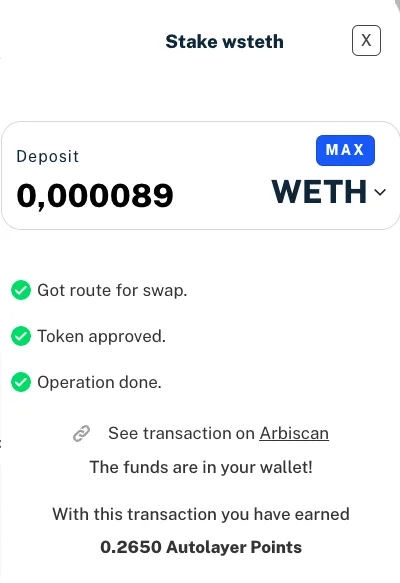
Note the sequence in the image: it finds a route for the swap, approves the token and completes the operation, all within one flow. That matches the description of an intent engine plus consolidation.
How points work
The post explains the incentive mechanism of V1 in a few sentences:
- AutoLayer uses a proxy contract. “Each time funds pass through it, we tally the points that will be added to the user’s wallet.”
- “Users earn 1 point for every dollar in value traded.”
- Points “will be converted into tokens during a future airdrop”.
- Points are “securely recorded on a smart contract”, which would serve as the oracle for distribution.
- A referral programme, paying in points, was planned “soon”.
The word that matters is future. A point is a record, not a token. The application says the team intended to convert points into tokens, linked to a native token it described as scheduled for around 25 April 2024. As of the post, that had not happened. Points carry no guarantee of value, a token or a conversion rate.
The arithmetic
Because the rule is one point per dollar traded, the calculation is direct:
| Value traded | Points (at 1 point per $1) |
|---|---|
| $10 | 10 |
| $250 | 250 |
| $5,000 | 5,000 |
The screenshot above shows a very small trade earning a fraction of a point, consistent with a rule based on value. We do not know how the value is measured (at execution price, for example) because the post does not say.
Incentive design in the grant plan
The application also describes how it would distribute grant incentives if approved: a separate contract would pay ARB and the project’s own token according to volume, with caps per wallet and per day, and with wallets linked to the DAO or its members blacklisted. Those details belong to the grant proposal, not to the V1 points system, and they were conditional on approval. We mention them only so readers do not mix the two: points are the standing system, the grant distribution was a proposal.
Where intent routing helps and where it does not
Intent routing is useful when many venues compete for the same trade and the best one changes from minute to minute. It is less useful if the underlying liquidity is thin, since no route can fix that. Consolidation reduces friction but does not reduce the risk of the protocols called in the bundle. Each additional integration adds a smart contract to the chain of trust.
A short checklist before using any routed strategy:
- Read what the transaction will do, step by step.
- Check the token approvals you are granting and for how much.
- Compare the quoted outcome with a direct route for a small amount.
- Start small.
Where this connects
Routing is the base layer under the other features. Auto-compounding in the compounding article depends on swapping rewards into ETH. Scoring in AVS scoring and LRT rehypothecation risk helps choose where to route funds. The how it works page shows the whole flow, and the risk disclosure lists the hazards. For the history of the project, see From Tortle Ninja to AutoLayer.
Takeaway
According to the application, AutoLayer does not trade for you. It picks the route, bundles the steps into one transaction, and records one point per dollar of value that passes through its proxy contract. Points were promised as a future token conversion, not delivered. Verify the current behaviour in the app before acting on any of this.